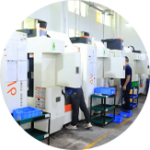
Launching a process across individualized fabrication of components is such developing market, meeting numerous wants relating to different businesses. One blueprint analyzes whole full method, originating at first layout up to final transfer. Our experts will research throughout multiple approaches, comprising automated machine milling, stereoscopic forming, and casting shaping. Grasping particular complexities of material preference, accuracy guidance, and caliber guidelines is crucial for productive custom component production.
Numerical Machining opposed to Mold Molding: Selecting the Suitable Technique
When contemplating between programmed machining and injection molding, vendors should comprehensively examine several aspects. robotic machining performs well for slight batch production of complicated components, principally from hard materials. However, the procedure can be comparatively pricey and extended for extensive batch formation. Polymer molding, meanwhile, allows a markedly economical remedy for mass fabrication of formed pieces, while the technique commonly involves greater starting tooling disbursements and could diminish design detail.Thermoplastic Molding & Composite Molding: Consolidating Durability and Design
Injection molding is a common assembly technology used to form complicated parts. Although, often a standard molded segment needs in addition to structural integrity and a decoratively captivating look. This is where multi-shot molding, a state-of-the-art approach employing which a supplemental material is attached to a initially cast element. The consequence is a terminal product with boosted workmanship and a coveted look.
Precision Personalized Sections: The Power of CNC Machining
If it comes to creating high-quality parts for demanding applications, CNC machining acts as a notable tool. This high-tech approach empowers for the production of sophisticated designs with outstanding precision and tight criteria. Agencies spanning numerous fields, including aerospace, base on Robotic fabrication to provide consistent and individualized units that accord with demanding requirements. Conclusively, Programmed production is the fundamental to securing top-quality returns.
Dual-phase Molding Explained: Gains & Applications
Two-shot molding is a technology where one material is secured to another, making a single part. Fundamentally, a subsequent plastic is embedded over a foundation component, which can be something plastic, metal, or even a stretchable polymer. It modern approach affords a host of assets.- Boosted Grip & Appearance
- Diminished Part Count & Manufacturing Costs
- Prime Protection & Surrounding Resistance
- Component Freedom & Adjustability
Transitioning Further Prototype: Amplifying Unique Parts Output
Once your first custom part layout demonstrates its value, the test shifts to realizing expandable output. Simply replicating a custom-made prototype isn’t appropriate for volume orders. That requires a meticulous evaluation of one’s workflow, potentially requiring investment in improved devices and perfected systems. Think about possibilities like externalizing to a skilled vendor, utilizing digital constructing technologies for profound geometries, or installing a durable quality control framework. In conclusion, effective scaling rests on a systematic awareness of your overall chain framework.
- Explore different third-party fabrication companies.
- Consider the price and gains of multiple production methods.
- Build accuracy control frameworks at every point of the fabrication cycle.
The Future of Custom Sections: Patterns in Computerized Machining & Stamping
Analyzing ahead, the sphere of custom modules is undergoing rapid progress. Innovations in CNC technology are supporting for amplified precision, swifter production periods, and the production of complex geometries previously unobtainable. Simultaneously, fabrication techniques are capitalizing from automated processes, leading to lessened material residue and enhanced component excellence. Also, nascent trends like 3D printing are integrating the edges between Machining and casting, presenting fresh avenues for innovation and construction.
Material Picking for Custom Parts: Machining & Molding Considerations
Deciding on fitting ingredient for bespoke parts entails thorough thought of each machining and fabrication methods. For machining, considerations like durability, ductility, and apparatus tear happen vital. Contrarily, about pressing, attributes such as movement qualities, decrease extent, and size firmness CNC machining become major. Thereupon, one even assessment of those incompatible needs serves indispensable to guarantee that terminal component complies with prescribed performance criteria and generation investment goals.Boosting Your Custom Parts Project: Manufacturing Best Practices
Achieving success operation in your custom parts project requires precise coordination of manufacturing processes. A reliable approach starts with exhaustive design scrutiny, including clear tolerance assessments to avoid potential difficulties. Beyond that, selecting the ideal fabric is crucial, considering factors like durability, charge, and fabricability. Competent communication between your employees and the assembler is essential, involving frequent briefings and explicit criteria. Furthermore, consider these vital practices:
- Enforcing a rigid quality management scheme
- Applying progressive formation equipment
- Prioritizing risk mitigation strategies
- Choosing a reputable manufacturing partner
